
Newsletter – 1st June 2026
The LostCousins newsletter will be published once or twice a month while we are in transition. To access the previous issue click here.
To go to the main LostCousins website click the logo at the top of this newsletter. If you're not already a member, do join - it's FREE, and you'll get an email to alert you whenever there's a new edition of this newsletter available!
In This Edition:
Double Lives, and Double Trouble: Two newly published books with AN EXCLUSIVE 30% Discount for Members!
Historic Devon Records Go Online for the First Time, Revealing Life Before WWI
TheGenealogist Offer: Get Diamond Subscription for the Price of Gold and Save £76 Today!!
Persistence pays off to great effect
Transcriptions using AI: a methodology to try
More on Transcriptions
Research Paper: John Ross Dunn, Esq. (1697–1783): Virginia Pioneer, Prolific Patriarch & Early Rowan County Founder
Feedback
Events
Double Lives, and Double Trouble: Two newly published books with AN EXCLUSIVE 30% Discount for Members!
As some members may know, Peter reviewed several books on genealogy and genealogical mysteries prior to piublication. This enabled him to indulge his favourite passion, help authors in need of an early critical eye, and write book reviews to coincide with publication. Last year Peter performed this role one last time for Professor Rebecca Probert, the well-known academic and author specialising in marriage law and related topics. Professor Probert has expressed her thanks to Peter and to Lost Cousins members:
“Research and writing can be a lonely process. You can beaver away for years on a book, cloistered away in your study and growling at interruptions. Then there are the months of waiting for it to be published – and usually far longer before anyone reviews it, or even tells you they have read it.
This is one of the many reasons that I have been so grateful to Peter, and to all the readers of Lost Cousins who have responded so generously to my calls for information. It’s a long time now since I asked readers for information on bigamous ancestors who were never prosecuted, but the results were revelatory. In most cases, it appeared, there was a very good reason why the individual in question was never prosecuted – either they had waited long enough that they would have had a defence to any criminal charge, or they had moved far enough away to avoid detection (for the full findings, see Escaping detection: illegal second marriages and the crime of bigamy | The Journal of Genealogy and Family History). These findings called into question the idea that bigamy was widely tolerated in earlier centuries.
In my two new books – out this week! - I build on these findings. Double Trouble draws on over 10,000 cases from the c17th to the present day to track changes in the incidence, prosecution, and punishment of bigamy. It shows that it was a far nastier offence than most accounts acknowledge, as well as being far more harshly treated, far less acceptable, and far less common. And Double Lives looks at some of the fascinating backstories and unexpected sequels of bigamous marriages over that period.
Both books are dedicated to Peter, who – after my husband – was the first person to read the entirety of Double Lives in draft. I was worried about imposing on his time, so I only sent him a couple of chapters to start with. His enthusiasm and request for further chapters was just the boost that I needed at that stage of the project. He also had some excellent suggestions, both in terms of the family background and the interpretation of certain terms used in the census.
When he was arranging the annual prizes for readers of Lost Cousins, Peter also asked me to give a talk on some of the stories featured in Double Lives – so watch this space!
In the meantime, both books are available from Bloomsbury. I’m afraid academic monographs are notoriously expensive, but the publishers have agreed that members of Lost Cousins will be entitled to a 30% discount – just enter LCDTDL30 at checkout on the publisher’s webpage:”
I would add that Peter always felt privileged and excited about reviewing Professor Probert’s work, and he would have felt deeply honoured by her dedication of these books to his memory. I will certainly treasure my copies as a reminder of Peter’s happy immersion in Double Lives during a deeply difficult time.
While the best textbooks are expensive, this does tend to reflect the calibre of research and writing. Perhaps the 30% discount might enable some of the Family History Societies to invest in Professor Probert’s books as library copies? Just a thought!!
Historic Devon Records Go Online for the First Time, Revealing Life Before WWI
TheGenealogist releases the Lloyd George Domesday Survey for Devon, featuring more than 352,000 people and organisations across over 2,500 square miles of historic maps
A remarkable snapshot of Devon life in the years before the First World War has been made available online for the first time by TheGenealogist.
The newly released Devon Lloyd George Domesday Survey opens up detailed records of homes, farms, shops, estates, inns, businesses and communities across the whole historic county. The collection includes 352,478 people and organisations, linked to more than 2,500 square miles of historic maps.
For the first time, these Devon records can be explored online alongside detailed period mapping through TheGenealogist’s MapExplorer™. This allows users to see not only who lived or worked in a particular place, but exactly where that property stood.
The Lloyd George Domesday Survey, officially known as the 1910 Valuation Office Survey, was created after the Finance Act of 1910. It recorded land and property across England and Wales, noting owners, occupiers, property descriptions, land use and values.
More than a century later, the survey offers a vivid picture of Edwardian Devon. From Dartmoor farms and country estates to market towns, fishing villages, seaside resorts and busy urban streets, the records show the county at a moment of great social and economic change.
A lost village preserved in the records
One of the most striking stories found in the Devon release is Hallsands, the fishing village near Start Point that was later destroyed by the sea.
The survey captures Hallsands before the devastating storm of January 1917, when high tides and easterly gales destroyed much of the old village. The records show the community as it still stood in the years before disaster struck.
Among those connected with Hallsands was Elizabeth Ann Prettejohn, remembered locally as the village’s last inhabitant. She remained in the one surviving cottage above the ruined settlement for decades, becoming a final living link with a lost Devon community.
TheGenealogist’s latest article, “Hallsands: A Village Lost to the Sea”, explores the history of the village and the story of its final resident.
Bringing people and places together
The Devon Lloyd George Domesday Survey is fully integrated with TheGenealogist’s MapExplorer™, making it possible to move between records and maps to locate properties with accuracy.
This makes the collection useful for anyone interested in the history of Devon, the story of their home, the development of a village or town, or the lives of people who lived and worked in the county before the First World War. Users can explore farms, cottages, shops, inns, estates, institutions and streets, then compare the historic landscape with modern mapping.
Mark Bayley, Head of Content at TheGenealogist, said:
“These Devon records are being made available online for the first time, opening up an extraordinary view of the county as it was just over a century ago.
Devon has such a rich range of landscapes and communities, from fishing villages and harbour towns to moorland farms, country estates and growing seaside resorts. The Lloyd George Domesday Survey lets people step back into that world and explore the places their ancestors called home.
Hallsands is a particularly moving example. The survey captures the village while it was still a living community, before the sea took so much of it away. When you can connect people such as the Prettejohn family to a real place on a historic map, the records become much more than names and numbers. They help bring local history back to life.”
The Devon Lloyd George Domesday Survey is now available online for the first time to Diamond subscribers at TheGenealogist. You can explore the collection at: https://www.thegenealogist.co.uk/lloyd-george-domesday/
TheGenealogist Offer: Get Diamond Subscription for the Price of Gold and Save £76 Today!
TheGenealogist are generously offering their top Diamond subscription for the price of Standard, now just £129.95 for the year (usually £169.95).
You’ll also receive a free online magazine worth £36, giving you monthly insights into the world of family history for an entire year.
Explore these new records and start your genealogical journey today with TheGenealogist by claiming this offer here: https://www.thegenealogist.co.uk/affiliate/?affid=lzupkh&page=3065
This offer expires on 15th August 2026. Many thanks to Mark, Paul and their team for enabling LostCousins members to benefit from such an attractive discount.
Persistence pays off to great effect
Ray, based in Tasmania, sent me this example of combining paper research, DNA results, collaboration with other relatives and a great deal of persistence to discover the identity of an unknown shared ancestor:
“I have not mentioned any given names in case relatives may happen to read the article as it is a sensitive topic for the lady. I think it is a good example of how DNA matches and records based research together can further research.
A few years ago, I contacted a lady with a reasonably close DNA match from Ancestry, but when I contacted her she said she did not have any connections to my family names, and no connection to Tasmania, and had been born in South Australia. I rechecked my DNA matches and found that each of our shared matches were members of Hayes and Kaine families from Tasmania. I contacted the lady again and explained the matches. She replied and told me that she did not know her father's identity. Her late mother had told her that her father was serving in the Navy, on a ship that had visited South Australia, and the name of the ship, but no other details.
I searched old newspaper articles on TROVE, (the National Library of Australia has digitized a large number of old newspapers and magazines etc. and they can be searched and the text "read" by optical character recognition (OCR) software can be corrected). I found a number of articles about the ship, including several about the ship being grounded on a sand bar during a severe storm. While the captain waited for a favourable high tide and another ship for a tow, most of the crew were given shore leave. A Google search revealed that a book had been written about the ship, and it included a list of crew names. The book was not available here in Tasmania and was not available for inter-library loan.
I contacted the National Library and explained the reason for my research and asked if the crew list pages could be copied or scanned. Fortunately, the staff agreed and sent me scans of those pages. I then worked my way through the list, comparing them to names in my RootsMagic genealogy software database. On the third page I found a match, to a Hayes descendant I knew had served in the Navy. I obtained a copy of his brief service record from the National Archives of Australia, and he had served on the ship during the relevant time frame.
I contacted the lady again and explained that I had ascertained the name of the man likely to have been her father. She remembered that her late mother had mentioned that her father had a twin brother, the man in my database was a twin, and both brothers had served in the Navy but only one of them was on that ship.
I was able to contact another DNA match, closer to the lady than mine. He knew the late twins and was able to contact an elderly aunt who confirmed that the brother who served on the ship had a daughter, who had visited the man in New South Wales with her mother, and the daughter had accompanied him to a Navy function. The second contact had photos of both brothers and kindly agreed to provide copies to the lady.
The lady was very pleased to find out her father's name and some details, and to be able to obtain some photos. She said she had only taken a DNA test in the hope of possibly identifying her father and making contact with some relatives.
I was very pleased to be able to help, and to ascertain our family connections.”
While Ray used every available piece of information and skill to excellent effect, I can’t help thinking that the “difference that made the difference” in cracking this case was Ray’s persistence. Not only did he conduct a deep trawl of the newspaper archives; he did something that my father learned in the Navy – “If you don’t ask, you don’t get!” am also mindful that the lady in question played her part too, by remaining open to possibilities about her father’s identity that may have initially seemed implausible.
Transcriptions using AI: a methodology to try
David Snow (based in the UK) has offered this “how to” article for anyone contemplating AI transcription. Hopefully his method will encourage more experimentation, while cautioning against relying on AI output that might look like the “real deal”. It seems that the human eye is still a lot better at noticing what is not there!
“In the May 2026 Newsletter Sian asked if anyone had experience of using AI to decode old documents. My children have been encouraging me to experiment with Chat GPT in a number of areas so, whilst trying again to decipher a will from the 1850s that had been transcribed in ‘secretary’ script, I decided to have a play. The will, which runs to five full pages, was downloaded from Ancestry in 2015 and I had transcribed some parts of it; but there were lots of annoying gaps. Here are the first few lines to give you a flavour:
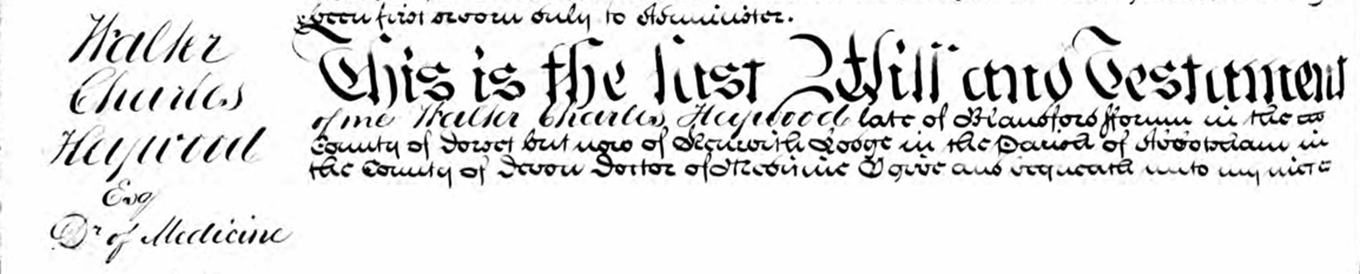
I uploaded one page at a time into Chat GPT and asked it to create a verbatim transcription of the will. The 1st attempt looked promising until I read it more carefully when I found out that some large sections were completely missing. However, the AI script read alright because it had invented script to make the output ‘sensible’; but overall it was useless.
Rather more understandably the rendering of family or place names was even more erratic, but that is easily corrected, Chat GPT can be told about these errors and a rerun will then have the names corrected.
AI told me that the document needed to be transcribed one page at a time, so I uploaded it in stages. I did this using a drawing package (I use CorelDraw), which allowed me to alter the image quality. The method was:
(a) Take a screen grab of ½ an A4 page of the original will
(b) Paste it into Word and save as a pdf
(c) Import the pdf to Corel and stretch it to A3 landscape size
(d) Export this file as a high-quality jpeg format
(e) Repeat for each ½ page of A4
(f) Upload jpeg files (2 per A4 page) into Chat GPT
(g) Copy and paste the returned transcription to MS Word.
I went through lots of iterations of this process before alighting on the above, during which the output steadily improved. However, be warned that the results need to be read VERY carefully with the original open on another screen to compare almost word by word. I used a second laptop to make this easier.
My original transcription from 2015 has 1165 words. My first try with Chat GPT gave a transcription with 1743 words. A later version using higher quality images from the drawing package had some 3500 words in the output, so much more complete but still some gaps and errors. The final transcription was perhaps 98% accurate and with hand adjustments of the errors runs to 3693 words.
Chat GPT offered a useful “Full Structured Summary”, followed by a plain English version of this summary, but be aware that this is based on the text it has at the time. Hence it offered an apparently logical and sensible summary of a document that had less than half the number of words; so still useless.
The transcription of the opening lines above is:
This is the last Will and Testament
of me Walter Charles Heywood late of Blandford Forum in the County of Dorset
but now of Kenwith Lodge in the Parish of Abbotsham in the County of Devon
Doctor of Medicine I give and bequeath unto my nieces
More on Transcriptions
Thanks to Tim Swayn in Canada, who wrote in to recommend a professional (human) transcription service that he has been pleased with.
“In your May Newsletter you mention a 500+ year old love letter that had been translated by AI. In my research I have encountered a number of documents that I have been unable to decipher because of
- unfamiliarity with words or more often locations
- acronyms and conventions for abbreviation that I did not understand (including exclusion of words altogether)
- inclusion of (or for older documents, being written completely in) latin
- bad handwriting
During Covid I discovered Transcription Services Ltd (located Isle of Man… I am in Canada) and cannot say enough about them. For an organization that have transcribed documents as important as the original Pride and Prejudice you might think the service prohibitive, but I’ve found it very affordable (the majority of the things they have transcribed for me have been a few pages each… wills and letters for the most part).
The transcription that is returned explains the transcription (abbreviations, translations, etc) and also those (rare) things that cannot be translated or are ‘educated guesses’. [The founder] Linda Watson has also, based on her experience, been willing to give me an idea about context when I’ve asked… for example in the early 1700s how common it would be to include certain types of things in a will, remember daughters, etc.
While not directly involved in genealogy (that I know) she has surely been exposed to the documents that we crave to see. She may well have tips and tricks that genealogists could benefit from. The website is https://transcriptionservicesltd.com/ and contains contact information.”
Research Paper: John Ross Dunn, Esq. (1697–1783): Virginia Pioneer, Prolific Patriarch & Early Rowan County Founder
In this extensively researched 40+ page case study, Joseph Leon Dunn reconstructs the complex life of his 6th great-grandfather, John Ross Dunn, Esq.:
“Born in 1697 in York County, Virginia, John became a surveyor, major landholder, and one of the earliest founders of Rowan County, North Carolina. He fathered at least 18 children and actively shaped the colonial frontier.
John’s identity had long remained elusive due to scattered records across colonies, name variations, complex family relationships, and earlier published errors.
Using primary records, land deeds, court documents, DNA evidence, and cross-referenced sources, the paper overcomes these challenges. Joe traced his ancestry to the 1620 Virginia immigrant Thomas Dunn from Worcestershire, and to his prominent Virginia Company ancestors from Devon, and further back to his Welsh ancestor, Sir Henry Dwnn ap Gruffudd.”
Joe has commented that “this detailed work will particularly appeal to members interested in Southern colonial families, migration patterns, and advanced genealogical methodology.” I believe that it might excite a wider audience in other countries where emigrants and their descendants shaped the development of towns, cities and populations across the New World. Do try to find the time to settle yourself in for quite a journey through Joe’s genealogical discoveries!
https://dunnfamilyofvirginia.blogspot.com/2023/03/john-ross-dunn-esq-1697-1783.html
Members who wish to get in touch with Joe about his research can contact him at josephldunn@yahoo.com
Feedback
Sue Holdsworth, one of our professional genealogist members, has offered a tip for searching the newly released 1926 Irish census:
“I have discovered that Ancestry now has links to it, and the searches are easier to navigate. From the Ancestry homepage, look for the card catalogue and the 1926 Irish Census should appear at the top.”
Many thanks Sue- anything that reduces the number of websites to search might come as welcome relief to many!
Chris, Catherine and several others wrote in to comment on their local connections with the Pease and Gibson families mentioned in Liz Lake’s article about Bridge End Garden in Saffron Walden. There were mentions – among several others - of the Pease family contribution to the creation of Middlesbrough, and the Gibson family house and garden at Balder Grange in Cotherstone (where the topiary in an old photo looks very similar to that in Bridge End Garden). The influence of Quaker investment in Britain’s industrial, railway and canal heritage, their philanthropic and charitable generosity, the abolition of slavery, reform of prison, welfare, banking and education, and their contributions in other areas (such as horticulture) were significant and have stood the test of time. By contrast, building a fast railway service from London to the North of England within budget and on time appears more challenging these days. Or perhaps we only tend to focus on the projects that succeeded.
Balder Grange was sold for £1.24m in 2020–21 and was included in a listing by the estate agents Strutt & Parker. The Strutt family was recently brought to my attention during a recent visit to the stunning and immaculately maintained Blunts Hall gardens in Witham, Essex. The property was mentioned in the Domesday Book and has a wonderfully long and interesting history; in the late 19th century it was home to by Charles Parker Strutt, brother of Edward, the co-founder of Strutt Parker. The Strutts of Belper were originally cotton weaving industrialists from Derbyshire; although they were Unitarians and not Quakers, their beliefs dovetailed with Quakers and other Enlightenment thinkers with whom they collaborated.
Enid wrote in to express her disappointment with David Ross's "Surnames of Scotland", commenting that it is a “a small book” which did not include either of her centuries-old Scottish surnames, Haddon and Cruickshank. She asked that I recommend “The Surnames of Scotland: their origin and meaning" by Dr George F Black as the more comprehensive and better-known text for genealogists.
I invested in a copy of “The Surnames of Wales” and found the descriptions of the Lloyd, Jones, Davies and Williams surnames of my grandparents worth the investment, although relatively few surnames are examined in huge detail. A Canadian member asked if I would check whether her “Symonds” name was listed; variants such as Simmons were listed as examples of the many patronymic surnames (e.g. “Simon’s” or “Ap Simon”) that were commonplace across Wales. Having read the 14th century tales of the Mabinogion some years ago, I was also pleased to see more ancient Welsh surnames explained. If you haven’t read the Mabinogion, the tales of magic, giants, knights and medieval life will appeal to anyone who has enjoyed the Arthurian romantic tales (and yes, there are crossover appearances!) Mabinogion tr. by Sioned Davies
Sarah kindly wrote in with a link to the highly persuasive 1907 pamphlet by William Willett about the merits of introducing Daylight Saving Time. https://www.webexhibits.org/daylightsaving/willett.html
William Churchill was a strong supporter. A memorial sundial was erected 20 years later in Petts Wood, near Willett’s home; set on perpetual Summer Time, the inscriptions reads “HORAS NON / NUMERO / NISI ÆSTIVAS (“I tell only the summer hours”). Having experienced the UK’s first heatwave of 2026, I have secretly been hankering for a few winter hours!
Events (not aiming to be comprehensive, but to include a handful each month)
TNA Archives Fest 2026- a day out at The National Archives in London on 12th July. Tickets only £12 and selling fast!
https://www.nationalarchives.gov.uk/whats-on/events/archives-fest-2026/
BALH Conference in Sherborne, Dorset
The British and Local History Society is hosting a one-day conference on 17th October, “Rebellion and Protest across Six Centuries.” This will be held in the beautiful ancient town of Sherborne in Dorset. For those unfamiliar with the BALH, this conference is among several events organised with local history societies in different parts of the UK. Well worth checking their Events page from time to time, in case something is going to be held in an area of interest to you. Details of the event in Sherborne can be found here:
https://www.balh.org.uk/dorset26
ScotlandsPeople – new videos of services
The National Archives of Scotland, aka ScotlandsPeople, have launched a series of YouTube videos to update researchers about the wide range of records and services available. Even if you think you know what they have, there could be something you’ve missed…
The Society of Genealogists (SoG)- Poor London Week
This event is available in person or online from 21-25th September. It is a 5-day immersive event which includes an impressive list of walks and talks, coupled with time to research and obtain individual guidance at the SoG. As the title suggests, this event focuses on the “underbelly” areas of London and related records. Having worked in the City of London for over 30 years, I know how fascinating it is to visit some of the buildings and streets in parts of London that are steeped in social history, yet rarely (if ever) frequented by tourists. There are multiple attendance options for those who don’t want to attend the full programme- take a look:
https://portal.sog.org.uk/Event/view/1608837
Last Word
The UK is reaching the end of a 2-week heatwave, and while the garden is very dry, it is full of peonies and roses in bloom. The Gertrude Jekyll rose I planted five years ago outside the study where Peter wrote his newsletters has oddly doubled in size this year; it is one of the most romantic and reliable roses that I’ve ever planted – and as such, a perfect reminder of Peter. It’s a very fragrant pink rose, and he would often stop to smell that one while passing by many others. I try not to have favourites in the garden but always give Gertie a good sniff these days!
Wishing you a happy and healthy month of genealogical fun and discoveries, whatever the weather and wherever in the world you happen to be.
Sian Lloyd,
Lost Cousins
The LostCousins newsletter is usually published 2 or 3 times a month. To access the previous issue (dated 1st May) click here; to find earlier articles use the customised Google search between this paragraph and the next (it searches ALL of the newsletters since February 2009, so you don't need to keep copies):
To go to the main LostCousins website click the logo at the top of this newsletter. If you're not already a member, do join - it's FREE, and you'll get an email to alert you whenever there's a new edition of this newsletter available!
© Copyright 2026 Sian Lloyd and Lost Cousins Limited
Please do NOT copy or republish any part of this newsletter without permission - which is only granted in the most exceptional circumstances. However, you MAY link to this newsletter or any article in it without asking for permission - though why not invite other family historians to join LostCousins instead, since standard membership (which includes the newsletter), is FREE?
Many of the links in this newsletter and elsewhere on the website are affiliate links – if you make a purchase after clicking a link you may be supporting LostCousins (though this depends on your choice of browser, the settings in your browser, and any browser extensions that are installed). Proud to be an Amazon Associate and an eBay Ambassador.