
Newsletter Edition – 1st August 2026
The LostCousins newsletter will be published once or twice a month while we are in transition. To access the previous issue click here.
To go to the main LostCousins website click the logo at the top of this newsletter. If you're not already a member, do join - it's FREE, and you'll get an email to alert you whenever there's a new edition of this newsletter available!
In this edition
July Newsletter emails – an apology
The Avon Took Three: The Forgotten Tale of a 19th Century Tragedy by John Brechin
FTAnalyser- a brand new “must have” for family historians!
Great Aunt Mary’s bigamous husband
Gill’s Puzzle: The Will of a 2-Year-Old?
Last Call: TheGenealogist Offer – expires 15th August!
Gardener’s Corner
July Newsletter emails – an apology
Members usually receive an email each time there is a fresh newsletter to read on our website. The July newsletter emails did not land perfectly for several members, and I am still perfecting the art of getting the links to open properly on all types of devices. I was absolutely mortified to discover that an error had appeared in a proportion of emails, and members were right to express concern. The error was created when the emails were sent out – the main database of member information, the ancestor records and all other aspects of Lost Cousins remain as intact as ever. However, the responsibility for getting it right falls to me and not only do I apologise, but I have committed to making meaningful improvements sooner than I had anticipated. This is no criticism of Peter- he built Lost Cousins, knew its peculiarities and could fix most things himself. There will be more updates and user involvement as the work evolves; in the meantime, I encourage you to keep building your ancestor base and using the site as usual. And if you are minded to become a Friend or renew the voluntary subscription (£10 single, £12.50 joint pa) this will help to defray the expenses incurred.
August is often described as a slow news month, or alternatively the “silly season” where some news isn’t really news at all. However – there is always something newsworthy in the genealogy world! This month’s main contributors -Alexander Bisset and John Brechin - are both based in Aberdeen, and they each have something special to read about. I really hope that some of you will a) enjoy reading John’s book and b) use Alexander’s fabulous https://ftanalyzer.com/ website to help improve your family tree (free of charge!). Margaret wrote in from New Zealand to share the story of her great-great aunt Mary- although your attention might be drawn more to her (at least twice?) bigamous husband Robert Hargreaves who didn’t get away with it completely… and then we have Gill’s very odd puzzle about a 2-year-old child’s Will. Some members have been asking about my garden- we’ve had no rain for almost two months, and I’ve written a brief article on my observations.
Unlike John in the next article, I haven’t researched deeply enough yet to write a book about my ancestors… but it’s always fascinating to know what first motivated someone to begin their genealogical research. For me, it wasn’t Peter nagging that I should “do my family tree” because neither of us could ever tell the other one what to do! What really got me started was an out-of-the-blue email from my cousin Anita, who had pieced together a lot about the Lloyds back to the mid-1800s but had hit an unusual “wall” trying to identify which of four women had married our great-great grandfather. Effectively, she tipped it all into my lap in a surprise email and I felt intrigued enough to take the bait. Two days later I had pieced the evidence together to show that he had married all of them (in turn, I should add); our great-great grandmother was his third wife. I am yet to trace forward to the descendants of all his children, many of whom will be in North America.
That’s enough about me and mine – let’s find out what other members have been up to!
The Avon Took Three: The Forgotten Tale of a 19th Century Tragedy by John Brechin
“Hi my main hobby is family history. I really enjoyed Peter’s book reviews, particularly the novels that had a genealogy basis. I had plans to write a book and had hoped that someday Peter would give it a positive review…
My great grandmother was Alice Maud Wagstaff born in Stoke Lacy and she ended up meeting an Aberdeen lad in London, married there and came up with their 2 daughters and a son to the granite city. She was the daughter of Thomas Wagstaff who appears briefly in the novel as a newborn babby.
I researched the Wagstaff and other lineages (Adams, Turner, Whistance, Jones and more) leading to them. And my wife and I had the pleasure of visiting Shropshire, Herefordshire, Gloucestershire, Wales, and of course Worcestershire about 15 years or so ago. Unfortunately, our visit to Bredon [in Worcestershire, on the banks of the River Avon] coincided with a biblical downpour that stopped us even exiting our car. This is slightly ironic as in later years in Newspaper articles of 1835 I found the sad story of my 3 x great uncle Thomas Wagstaff of Bredon drowning in the Avon which was in spate after heavy rains. The babby Thomas was born days after his uncle’s funeral. There were two other young men drowned in the same incident Daniel Trapp also of Bredon, and Charles Stephens of Alderton. Later I found an article mentioning an 1838 criminal trial brought about by John Wagstaff (my 4 x great grandfather) against Cornelius Stephens, both blacksmiths of Bredon. I told my immediate family of these stories, and my niece suggested I should write a book about it. It intrigued me, but I did nothing until retirement allowed me time to sit down and write.
The novel is my fictionalised story of what may have happened between these two factual incidents.
The retirement was meant to give us time to revisit our grand tour of the counties and country previously mentioned, but with more time to explore, and finally get out and walk in Bredon. Unfortunately, soon after my retirement my wife was diagnosed with Cancer and her ongoing treatment has curtailed those plans for the time being. That is also the reason all royalties from the sales of the ebook and paperback at Amazon are being donated to Cancer Research UK.
The Avon Took Three: The forgotten tale of a 19th century tragedy https://amzn.eu/d/09M9Kjqa
My book is available from Amazon for £4.99. Any profits from book sales will go to Cancer Research UK; that means anything I receive from book sales – Royalties are 70% for ebooks, 30% for paperbacks - will go to Cancer Research. So as you can see the charity will get more (£3.49) if you buy the ebook. If you don’t have a kindle, that’s not a problem, you can still read ebooks on your tablet or phone, just go to your App Store and download the Kindle app for free. The link is offering the book for £0.00 if you enrol in Kindle Unlimited, which costs £10 a month thereafter - but it would be better for the charity if you ignore that and buy the ebook at £4.99. The Avon Took Three: The forgotten tale of a 19th century tragedy https://amzn.eu/d/09M9Kjqa
The paperback option will be available soon, but to make the charity some money due to the poorer royalty figure it will be a fair bit more expensive. Thank you, John Brechin”
John- all best wishes to your wife for a strong recovery. Peter would have supported your book especially given the charitable aspect, and I hope that our members will be similarly generous.
FTAnalyser- a brand new “must have” for family historians!
Many of you will already know Alexander Bisset as a long-term collaborator and supporter of Lost Cousins. Alexander has combined his professional IT skills with his undoubted passion for family history research to launch a new product designed to analyse our family trees in depth. Although my family tree is not very impressive (yet) and I would love to see the results of Peter’s vast tree analysed by Alexander’s software, the results and suggestions can be equally helpful to both newer and more experienced researchers. And – it’s free!
Here is Alexander’s own introduction to his website:

Family Tree Analyzer: Find the hidden depths in your family tree
“I've been interested in family history since meeting numerous previously unknown relatives at my grandfather's funeral in 1981. I was a teenager and pieced together a small tree from conversations at the wake — a burst of enthusiasm that faded as computers took over my attention.
It was my grandmother's death in 2003 that rekindled things. Visiting her grave to photograph the inscription for my dad, I was struck by the detail on the stone: not just my grandparents, but my great-grandparents and 2x-great-grandparents were all listed on the one stone.
That sent me back into the archives, and my research was super-charged by access to Scotland's People — within three weeks I'd filled out all 32 of my 3x-great-grandparents, all but one of whom lived their whole lives in North-East Scotland. I joined the Aberdeen & NE Scotland Family History Society soon after and have been a member ever since. I lost interest again for a time after my mother died, but retiring in December 2025 and starting to volunteer at the Society's Research Centre in King Street, Aberdeen brought it all back.
In the early days, I found searching for records and checking I'd entered everything correctly pretty tedious — I kept finding mistakes that could have derailed my research. Since I worked in computing, I built myself a program to double-check my data. At first, it just searched the old International Genealogical Index (IGI) records at FamilySearch, but it grew from there. In the early 2010s, a DNA cousin became my first proper tester, offering suggestions for improvement.
Around that time, I got involved with the Lost Cousins website, helping founder Peter Calver set up his new forum. With input from enthusiastic forum members — and especially fellow admin Tim Nicholls — the program took shape with a wave of new features. Most of what's in FTAnalyzer today is thanks to this community, which is exactly why it's completely free to use: my way of giving back for all the help I've had over the years.
So, what is FTAnalyzer and why might you want it? Put simply, it does a deep analysis of your tree. At the simplest level, it flags errors you may not have realised were there — similar to the costly “Pro Tools” on Ancestry or the checking tools in programs like Family Tree Maker. The difference is that FTAnalyzer's checks go further, and it also lets you export a wide range of reports to Excel.
For example, the Research Suggestions tab shows what research you've done for a census. Pick UK census records and the colour-coded report shows you, person by person, whether you've already found them in the census for the years they were likely alive.
Select Ancestry from the drop-down menu at the top of the Analyzer page and — if you're signed into Ancestry at the time — double-clicking a coloured box opens an Ancestry search form for that census year, already filled out with the person's details. It saves hours of form-filling and supercharges your ability to find records.
Now, you might be thinking “sounds great, but I don't want a program changing my tree — I've spent too much time on it”. Never fear! One of FTAnalyzer's core design principles is that it only ever works on a copy of your data. YOU decide if a search result is correct. YOU decide whether to add it to your tree. FTAnalyzer will NEVER change your tree — it only ever makes suggestions for you to assess.
FTAnalyzer also lets you:
• Plot your ancestors' locations on a map
• Browse your tree by location, occupation, surname and more — handy new ways to spot gaps and typos
• Export a privatised, DNA-site-ready version of your tree, automatically stripped of private notes
• Check for duplicates
• Get suggested date ranges to narrow down births, deaths and marriages
• Automatically load your census finds up to Lost Cousins
That last one especially has saved many Lost Cousins members a lot of time and effort.
So how do you get hold of it? It's available on the Microsoft Store — just search for FTAnalyzer and click “Get” or “Install.”
Alternatively, visit https://ftanalyzer.com/releases and download it from GitHub. Once installed, use the File menu to load a GEDCOM file of your tree. (There's a documentation page at https://ftanalyzer.com/Documentation if you're unsure how to create one from your family history program.)
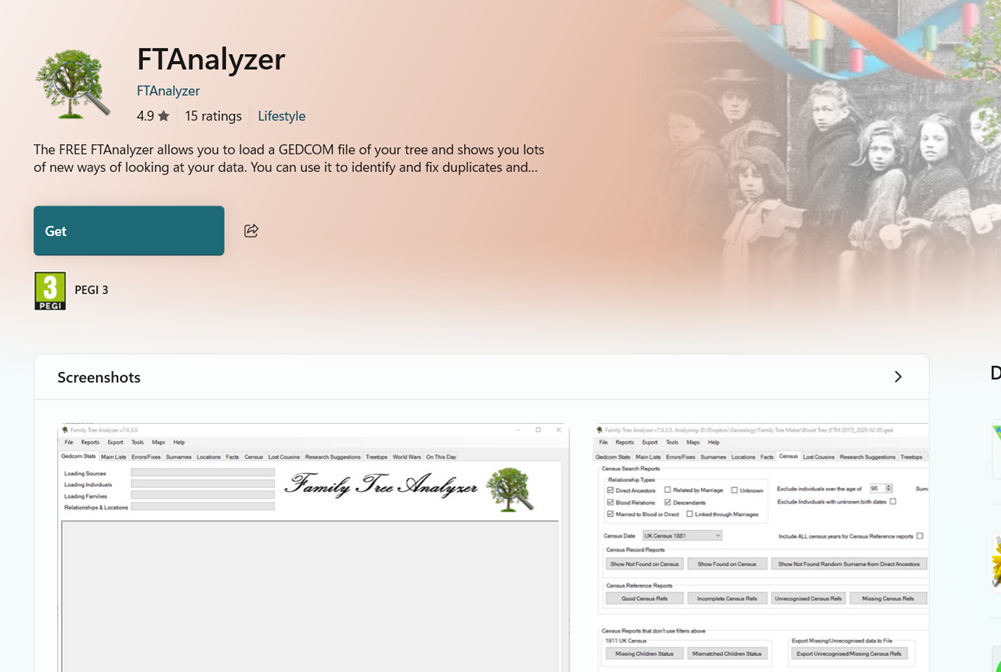
The FTAnalyzer product page on the Microsoft Store
As of July 2026, there's also a new web version at https://app.ftanalyzer.com. It's being updated constantly and doesn't yet do as much as the desktop app, but it works on tablets, phones and Macs, and needs no installation — designed to be a more visual, friendly starting point for less-experienced researchers. Just upload your GEDCOM and follow the instructions.
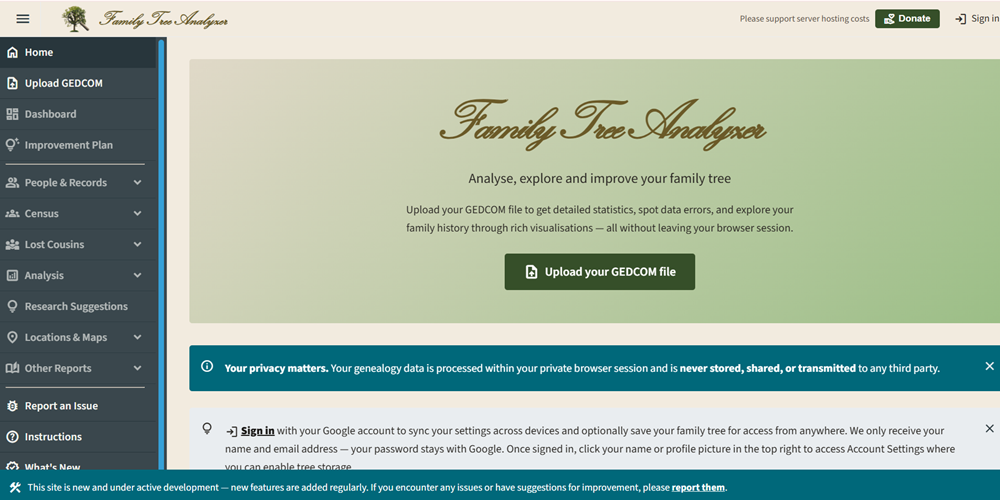
The program loads your file and reports any errors on the initial load — typically invalid or incomplete dates. A common mistake is a date like 1/6/26, which could mean 1st June 2026, 6th January 2026, or 1st June 1826 — since family history spans centuries, two-digit years just aren't safe to use.
It's genuinely satisfying to clean up these errors, export a fresh GEDCOM, and see a clean bill of health. From there you can explore location or occupation lists — double-click any item (say, the occupation “Agricultural Labourer”) to see everyone in your tree who shares it.
There's a lot to explore, and the app has a thriving Facebook users' community with over 3,000 members worldwide, alongside more than 5,000 users of the program itself. So why not join them for FREE and see what's hidden in your tree?”
Alexander Bisset, Developer of FTAnalyzer
Alexander, what a fantastic accomplishment and I hope that members will be keen to try FTAnalyser for themselves! Remember – it’s free, it won’t mess up your family tree, and it might suggest something vital to supercharge your research!
Great aunt Mary’s bigamous husband
This story comes from Margaret in New Zealand; she has written a more detailed version here https://www.wikitree.com/wiki/McLean-6981 and here https://www.wikitree.com/wiki/Hargreaves-1270. Even though this is already quite a story already, I have a hunch that there could be more to unravel…
Margaret’s great aunt Mary McLean was born on 21 February 1839 and raised in, Dundee, Scotland with her four younger siblings. Her father Donald McLean was a master tailor who married Helen McKinnon. The family emigrated from Scotland to the Colony of Victoria from Liverpool on 5 December 1857 on the ship, Merchant Prince. She arrived on 14 March 1858 at Melbourne and went with her mother to Geelong. Mary was listed as aged 18 and from Forfar.
Her future husband Robert Kemp Hargreaves was born probably in 1836 and baptised on 14 September 1836 at St Peter and St Nicholas, Liverpool, Lancashire, England. He was the son of William Hargreaves (a cooper) and Elizabeth Johnson. Although he was given the names of Robert Kemp, during his life he went by other names including Robert George, George and Charles Robert. The 1841 census shows him aged 5 living with his parents, two siblings and John Hargraves (a watchmaker aged 20 from Ireland) at Newsham Street, Linn Place, Liverpool (Note that the surname has been transcribed as Hargram). Ten years later, Robert was a watchmaker apprentice living with his parents, five siblings and a servant – his father now a publican.
Aged 20 in 1851 and now a watchmaker, Robert- the son of William Hargreaves (publican)- married Mary Ann Downes, aged 20 living at 15 Christian Street and the daughter of John Downs (pilot) on 12 June 1854 at St Philip in Liverpool.. Robert and Mary had four children: William, John Charles, Annie Ellen and Joseph.
In the 1861 census, Robert was living at Redmond Place, Liverpool with his wife Mary Ann (a dressmaker aged 26) and their three children. His entry lists him as a watchmaker aged 24 born in Liverpool.
Sometime after 1861 it is believed that Robert abandoned his wife and children and emigrated to the Colony of Victoria, Australia. Research by Lex Tucker has led to the belief that this was the man who married Margaret’s Great Aunt Mary (McLean) in August 1863 at the Congregational church at Williamstown. If so, it was a bigamous marriage. Mary and Robert had two children: Ellen born in 1864, and Samuel in 1866. Unfortunately, married life did not turn out well for Mary either: Robert deserted her in 1866.
Robert Hargreaves then married Ellen Cusack on 30 September 1867 at Wangaratta. But this time he was caught:
Charles Robert Hargreaves, a watchmaker, was brought up on warrant, charged with bigamy. From the evidence adduced it was proved that the prisoner married a young woman named Mary McLean, the daughter of very respectable parents residing at Williamstown, in the month of August 1863, and lived with her as man and wife until the middle of 1866, occasionally leaving her for six months at a time. The issue of the marriage was two children, which had left in the care of his wife, when he finally left her about the middle of 1866 telling his wife that she would never see him again. A short time since it was ascertained he was residing at Wangaratta, when a summons was taken out against him for the support of his wife and family. ln the course of the examination (although the prisoner pleaded poverty) it came out that he had married another young woman at Wangaratta in September last, having represented himself as a single man; hence the present proceedings. Donald McLean, the father of the prisoner's first wife, proved they were married in August 1863, by the Rev. Mr Jackson minister of the Congregational church at Williamstown, and his evidence was corroborated by several witnesses. George Devritt Galen, the Roman Catholic clergyman residing at Wangaratta proved on being sworn, that he celebrated the marriage between the prisoner and a young woman named Ellen Cusack, on 30th September,1867, at Wangaratta. The prisoner then signed his name as George Hargreaves. Miss Cusack was then only twenty years old, and the prisoner twenty-seven. He had, before marrying her, received the consent of Mrs Cusack, who was a widow. Several witnesses who had been brought down from Wangaratta, proved being present at the second marriage. After receiving a caution from the bench, the prisoner reserved anything he might have to say and was committed to take his trial at the Circuit Court, Melbourne, on Monday, the 17th of February, proximo.
He pleaded guilty at the court sitting on Monday 17 February 1868, was remanded for sentence and was subsequently sent to prison for a year. He came before the courts again in 1869 charged with deserting his wife and children and was ordered to pay maintenance.
Before Mr Mollison. Robert Hargreaves, a middle-aged man, was charged on warrant with deserting his wife and two children on the 27th of November 1867, at Williamstown. The prisoner was arrested at Albury, N.S.W., where he was working at his trade as a watchmaker, and remanded to this Court. It appears that in February 1868 he was tried in Melbourne for bigamy, and was sentenced to a year's imprisonment, and from that time to the present his wife and family heard nothing of him, nor had they received any assistance from him. He was ordered to pay 15s a week for twelve months, and to enter his own recognizance of £25 and find one surety to the same amount. As the surety was not forthcoming, he was sent to gaol.
His wife could not cope with being deserted, and his children were found wandering the streets in January 1870:
“Ellen Hargreaves and Samuel Hargreaves, aged respectively six years and four years, were brought up charged with being neglected children. They were found on the previous night in Stevedore-street, by the police, and brought to the watchhouse. Their mother was seen yesterday afternoon leaving the town with a bundle in her arms, and the children crying after her. Their father was now a prisoner in her Majesty's gaol. The bench committed the children to the Industrial School, each for a period of seven years.”
No record of what happened to Robert has yet been found after 1871, so his date of death is yet to be discovered. Did he move back to New South Wales or go to New Zealand or return to England? Did he assume a different name?
What I found most moving in all of this is the impact on great aunt Mary and her two children. But what happened to his first wife and their four children abandoned in Liverpool – was he ever held to account for this crime and how did they fare? Perhaps Margaret can tell us what happened to them; in some ways it seems that they might have been better off without him in their lives, were it not for the loss of financial security, and the treatment of and stigma borne by women and children abandoned by the family breadwinner.
Gill’s Puzzle: The Will of a 2-Year-Old?
Now, here is an interesting little puzzle. I have my own ideas about what might have happened but do please write in to info@lostcousins.com if you’d like to share your own observations and help Gill out!
“Good afternoon!
I wondered if readers would be interested in this... the age of the will and how it was ever written!
I’ve been doing my granddaughter’s family history and stumbled upon something rather amazing… and I wonder if it’s unique. It involves the age of the person leaving a will.
I’ll go back to the beginning:
Francis Plumley Lasbury (b. 16 Aug 1852 Gloucestershire - d1886 13 Sep 1886 Brant, Ontario, Canada)
married Elizabeth Anna E. McCrate (bap. 6 Oct 1850 Huish Champflower – d.2 Jun 1908 Bristol, Gloucestershire)
In Apr 1872 Bristol, Gloucestershire.
Francis was a ‘colonial broker’ in 1871 census.
The couple had two daughters, Elsie Frances born in 1872 and Ethel Marion born in 1876 both in Bristol.
By 1881 the couple and their children were living in Ontario, Canada and Francis described himself as a butcher. At some point, either Elizabeth or the whole family, travelled back to England where she gave birth to Herbert Francis Lasbury on 30 Mar 1884 in Barton Regis area. She then returned to Ontario. There, on 4 Mar 1886 they had another daughter, Gertrude Annie Lasbury.
Sadly, however, later that year Francis died and the family travelled back to England. His will was probated in England and gave his death date as: 13 Sep 1886 in Brant, Ontario, Canada.
So, presumably, Elizabeth attempted to piece her life together with her four children. However, the family was rocked by another death – her daughter, Gertrude Annie died on 8 Apr 1888 in Barton Regis at just 2 years old.
Then comes the surprise… on 9 Feb 1906 Gertrude’s will was probated! I can only think that the father, Francis, left an amount of money to be shared among the children… and it was this that Elizabeth had to prove in order to apply for probate. If a birth certificate was required, then perhaps they had to contact the authorities in Canada… it’s a mystery. Or perhaps the will was made in Canada and had to be verified. Unless other readers can come up with a possible scenario?
I am never ceased to be amazed at what sometimes turns up in family history... but this is up there with the best of them! “
Last Call: TheGenealogist Offer: Diamond Subscription for the Price of Gold expires 15th August!
TheGenealogist are still generously offering their top Diamond subscription for the price of Standard, now just £129.95 for the year (usually £169.95). You’ll also receive a free online magazine worth £36, giving you monthly insights into the world of family history for an entire year. Explore these new records and start your genealogical journey today with TheGenealogist by claiming this offer here: https://www.thegenealogist.co.uk/affiliate/?affid=lzupkh&page=3065
This offer expires on 15th August 2026. Many thanks to Mark, Paul and their team for continuing this offer so that more LostCousins members can benefit from such a generous discount.
Gardener’s Corner
I have hesitated to write anything about the garden this year, as it has received hardly any of my attention and suffered weeks of drought. When I have managed to get outside, it has been such good therapy that I hung a sign on the bay tree near the front door, “Gardening is better than therapy.” Not quite true, as my 25 years in clinical practice would exemplify; however, watching the garden transform in Spring did remind me of nature’s cycle of life and within this, the power of regeneration.
With no Peter around to cut the grass, I worked out how to use the battery mower and was getting a lot of exercise and satisfaction creating stripes with the mower.
And then the heatwaves came in May and have not really left us. Millions of gardens in the UK are currently subject to hosepipe bans, and even those who are exempt are mindful that much more water is being used than can be replenished for many months ahead. So, the plants sit there gradually withering, unable to seek further shade or water. The lush striped grass has become bleached dust dotted with the odd dandelion. And more recently we have seen wildfires across East Anglia; friends are messaging me to ask, “are you all right?” because they are aware that the ancient woodland around me is a tinderbox. Nowhere near as tragic as what is happening on the European mainland – but this is a far cry from the British summers of my childhood.
Surprisingly, the orchard is full of perfect fruit – it was a difficult enough moment, harvesting the first yellow gages - because that was always Peter’s greatest pleasure in high summer, as he geared up for jam making and preserving the fruit to last us through winter. I admit to a few tears before munching on a ripe gage, but then it suddenly dawned on me – there were no insects or birds eating their share. Even as I write this at dusk, there’s no evening chorus- merely the squawks of a pair of magpies. The very commonplace European bee buzzards haven’t been circling overhead for weeks, probably unable to feast on the hornet, bee and wasp nests that are usually in abundance in the woodland. What this change in climate means for our wildlife and the pollination of our crops next year, I dread to think. And I have now fully accepted that climate change is permanent, meaning that any replanting will require a lot of thought about summer drought and shorter, wetter winters. Probably not a lot of choice for clay soil that can rot roots in the winter and encase them in concrete over a longer and drier summer- but then, all gardening is an exercise in hope!
I do have some tips –
- It is better to water deeply and less frequently, than to give a plant a light sprinkle every day. Train your plants to literally root for water – encourage deep roots and they will survive for longer.
- All new plants need watering regularly for the first couple of years – even those in gravel gardens or labelled as drought tolerant. This is because the drought tolerance comes from a well-developed root system.
- Water the roots and don’t waste it over the foliage. Even if the flowers and foliage die back, healthy roots of shrubs and perennials will usually stimulate regrowth during cooler weather.
- A bucket of water left in the shade overnight will be better for most plants, especially lovers of acid soil. Tap water contains alkaloids – these will evaporate if left overnight.
- Don’t feed heat stressed plants. This is because feeding will compel the plant to grow while it is better left to cope “as is”.
- Put out a dish of water for the birds and other little creatures and refresh the water regularly to avoid disease. We need a balanced ecosystem for pollination, pest control and more.
- Fruit and food crops may ripen sooner than anticipated, so keep an eye on your fruit and veg!
- Garden wisely, in shade and cooler hours. Wear a sunhat, keep hydrated and keep the effort minimal. Hot weather is never the best time to dig or plant!
- Consider installing a rain barrel or other vessel to harvest rainwater. I have four barrels but could have used more.
And finally….
Thank you for continuing to support and engage with Lost Cousins, whatever has (and hasn’t yet) happened this year. It is a huge responsibility to inherit- my task now is to make it the very best that it can be!
Sian Lloyd
LostCousins
© Copyright 2026 Sian Lloyd
Please do NOT copy or republish any part of this newsletter without permission - which is only granted in the most exceptional circumstances. However, you MAY link to this newsletter or any article in it without asking for permission - though why not invite other family historians to join LostCousins instead, since standard membership (which includes the newsletter), is FREE?
Many of the links in this newsletter and elsewhere on the website are affiliate links – if you make a purchase after clicking a link you may be supporting LostCousins (though this depends on your choice of browser, the settings in your browser, and any browser extensions that are installed). Proud to be an Amazon Associate and an eBay Ambassador.