
Newsletter – 1st July 2026
The LostCousins newsletter will be published once a month while we are in transition.
To go to the main LostCousins website click the logo at the top of this newsletter. If you're not already a member, do join - it's FREE, and you'll get an email to alert you whenever there's a new edition of this newsletter available!
In This Edition:
A Challenging Month for Many
Learn how to write your own best seller with Nathan Dylan Goodwin – EXCLUSIVE OFFER!!
TheGenealogist Offer: Get Diamond Subscription for the Price of Gold and Save £76 Today!
How “Eleven Missing Days” can continue to confound genealogists
What Happened Here??
Scribe AI transcription: a full example
More on AI Transcriptions
Events in July
Last Word
A Challenging Month for Many
As the month of June passes into July, millions of people in the Northern hemisphere are still struggling to cope with record-breaking heatwaves that have caused deaths, illnesses, wildfires, closed schools, brought transport services to a standstill and impacted outdoor workforces - and there is the threat of yet more over the coming weeks. Unlike previous heatwaves, the intensity of this one has kept me indoors and doing not-a-lot. This year’s temperatures in the UK have approached 38c/ 100f; especially during June the night temperatures have also remained well above 20c, which has caused a nasty cycle of nighttime insomnia and daytime lethargy. Sometimes I have felt isolated, but the surrounding woodland reminds me that I am never truly alone. Last Thursday a muntjac deer was barking nonstop until almost 2am; tonight I’m being kept awake by a fox. Little wonder that our little cat Rosie didn’t fancy her usual nighttime roam in the woodland! It’s been so hot that she has been grateful for chilled food and a cool corner to rest in. For those who might be wondering how the garden is faring, I’d say that the plants are responding like the human of the house – heat stressed and not at their best, but aware that nothing stays the same for too long.
Learn how to write your own best seller with Nathan Dylan Goodwin – EXCLUSIVE OFFER!!
Are you looking for a new interest that will fit nicely alongside genealogy? Have you ever wanted to write your own genealogical crime mystery story? Now's your chance! Genealogical crime mystery author, Nathan Dylan Goodwin has launched a self-paced online course where he teaches you everything from the very beginning through to publication. No previous writing experience is necessary. The course is £127 but Nathan is offering the course to LostCousins members for £99 until the end of July. To find out more and take advantage of this special offer, go to https://www.thenovelguys.com/creativewriting and enter the code LostCousinsWrite at the checkout. Sign up and get writing!
TheGenealogist Offer: Get Diamond Subscription for the Price of Gold and Save £76 Today!
TheGenealogist are still generously offering their top Diamond subscription for the price of Standard, now just £129.95 for the year (usually £169.95). You’ll also receive a free online magazine worth £36, giving you monthly insights into the world of family history for an entire year. Explore these new records and start your genealogical journey today with TheGenealogist by claiming this offer here: https://www.thegenealogist.co.uk/affiliate/?affid=lzupkh&page=3065
This offer expires on 15th August 2026. Many thanks to Mark, Paul and their team for continuing this offer so that more LostCousins members can benefit from such a generous discount.
How “Eleven Missing Days” can continue to confound genealogists
Thomas (Bristol, UK) sent me this fascinating article for members who are interested in learning more about the “missing 11 days” caused by a reset of the calendar used in England and Wales from the Julian system to the Gregorian one used more widely across Europe. His explanation not only sets out several helpful tips but also dovetails perfectly with an intriguing question that another member posed. Even if your research hasn’t got back this far yet, this “spanner in the works” is likely to feature in everyone’s research of ancestry in England and Wales at some point. Read Thomas’s article first (I read it several times over!), and then you might be able to solve the puzzle in the next article yourself.
“Before 1752, Britain used a different calendar to the rest of most of western Europe. While the basic structure of the twelve months was the same, we were still using the "old style" Julian calendar, in which dates were slowly drifting away from the seasons, and in England and Wales the new year legally began not on the 1st of January but on the 25th of March!
By the end of the Roman empire, the start of the year had been fixed on the 1st of January, but medieval Christians felt that it would be more appropriate for the year to begin on a Christian festival. England had a system of "quarter days", consisting of religious festivals that fall shortly after each equinox and solstice: Lady Day (the Feast of the Annunciation) on 25th March, Midsummer Day (the Feast of the Nativity of St John the Baptist) on 24th June, Michaelmas (the Feast of St Michael and All Angels) on 29th September, and Christmas on 25th December. These were the days on which servants were hired and rents were due and, as Lady Day fell shortly before the beginning of the planting season, it was the most convenient for the start of leases on agricultural property - you wouldn't want possession of a field to change while the crops were in the ground! In 1155, Lady Day was fixed as the legal start of the year in England and Wales - although in practice most ordinary people continued to think of the 1st of January as New Year’s Day. Scotland also used Lady Day as the formal start of the year until 1600, when it switched to the 1st of January.
The main implication this has for genealogists is that dates between the 1st of January and the 24th of March can cause some difficulty. Original parish registers are usually fairly clear as to the order of events: the dates count upwards, and the only thing that appears unusual is that the heading for the start of the new year appears in late March instead of at the beginning of January. But transcriptions taken from the registers can be confusing, especially when the list is alphabetised instead of in date order, or when an individual date is shown in isolation. Care needs to be taken to ascertain whether the transcriber has put the year as it appears in the register, or whether they have "corrected" it to standardise on either of the possible dates for the start of the year. If you see a transcribed date in January or February 1725, for example, it can be unclear whether the transcriber means that it comes after December 1725 and before April 1726 (which is what would be in the original register), or if they have standardised it to the modern use of the calendar and it actually comes after December 1724 and before April 1725. It's particularly dangerous to assume from someone's notes based on someone else's transcription, as every time the year is "corrected" it has the potential to get one year further away from the truly correct year: it's not uncommon to find online trees where a year of a baptism between January and March is two or even three years different from when it actually happened!
The best practice for dates between the 1st of January and the 24th of March prior to the calendar change is to use "dual dating", in which both years are written - my own tree for example includes baptisms that took place on 3rd February 1628/9, 21st January 1669/70 and 22nd January 1699/700. This way of writing dates was a common practice even at the time, and in modern usage it clearly communicates not only the correct date but also the fact that the writer understands the implications of the pre-1752 calendar and that they have taken care to ensure that the date is correct.
It also goes without saying that best practice always involves checking the original registers, or at least scans of them available online, using the transcription as a finding aid. If you're working from a transcription that doesn't use dual dating, you'll have to check both possible years to find the right entry and can then record it correctly with dual dating in your own notes.
The difference in the start of the new year is most important to consider in cases of death in infancy. A baby buried in January or February could well have been baptised in November or December of the same year! This can be easy to miss if you aren't aware of when the year started.
A further wrinkle applies if you are looking at Quaker records, as the months are often numbered rather than named. Post 1752, "the 1st month" is obviously January, but prior to that it isn't safe to assume that it is definitely March. If you are lucky, the register will say something like "the 3rd [or 5th] month called May", but if not you will have to read through the rest of the register for clues: for example, if you can find two consecutive entries near the end of a month but dated a year apart, then that month must be March.
In some registers you will also see September abbreviated as 7ber, October as 8ber, etc. Don't read these as numerical dates and confuse them with July and August! The fact that the names of these months are off by two is completely unrelated to Lady Day, nor is it because Julius Caesar and Augustus added new months named after themselves - in fact the existing months of Quintilis and Sextilis were renamed in their honour. The earliest Roman calendar began with March, and the start of the year was later shifted to January without renaming the months. This is also why leap years have an extra day in February - it was originally placed at the very end of the year, although as the Roman calendar began by counting from the 6th day before the start of a new month, in leap years the additional day was actually implemented by counting the 24th of February twice!
The change of the start of the year in England and Wales was implemented by the Calendar (New Style) Act 1750, which stipulated that the 31st of December 1751 would be followed by the 1st of January 1752, and also formally fixed the leap day as the 29th of February. The better-known provision of the Act, however, was that all of Britain would adopt the "new style" calendar, now known as the Gregorian calendar, and so eleven days were skipped in September 1752: Wednesday the 2nd was followed by Thursday the 14th.
The Julian calendar, introduced by Julius Caesar in 45 BCE, had leap years every fourth year without exception, resulting in an average year length of 365.25 days. Unfortunately, this is slightly longer than the actual length of a solar year, 365.2422 days. This is only a small difference, but it's enough that Julian dates drift compared to the seasons by an average of one day every 128 years. The Gregorian calendar, instituted by Pope Gregory XIII in 1582, leaves out the leap days on years divisible by 100 but not by 400 - so although 2000 was a leap year, 2100, 2200 and 2300 won't be. The Gregorian calendar was adopted by different countries at different times, and so varying number of days had to be skipped to catch up with it, depending on how far the Julian calendar had drifted: Britain had to remove 11 days in 1752, but by 1918 Russia had to skip 13 days. Even the Gregorian year doesn't match the solar year exactly, but it will be over 7000 years before the average error is greater than one day.
Incidentally, the reason why the British tax year begins on the 6th of April is also down to the 1752 changes in the calendar! Previously, the tax year ran "from" Lady Day, although an old legal rule meant that the word "from" was interpreted as starting on the following day, the 26th of March. Shifted by eleven days to account for the change in calendar, this becomes the 6th of April.
Unfortunately for those of us who enjoy a good story, the well-known riots demanding "give us our eleven days" are not mentioned in any contemporary records and are in fact completely fictional. The slogan comes from a painting, An Election Entertainment by William Hogarth, which satirises the tone of the debate in the 1754 election, in which the Tories attacked the incumbent Whigs for every decision they had taken, including the adoption of a "Popish" calendar.”
And so… What Happened Here??
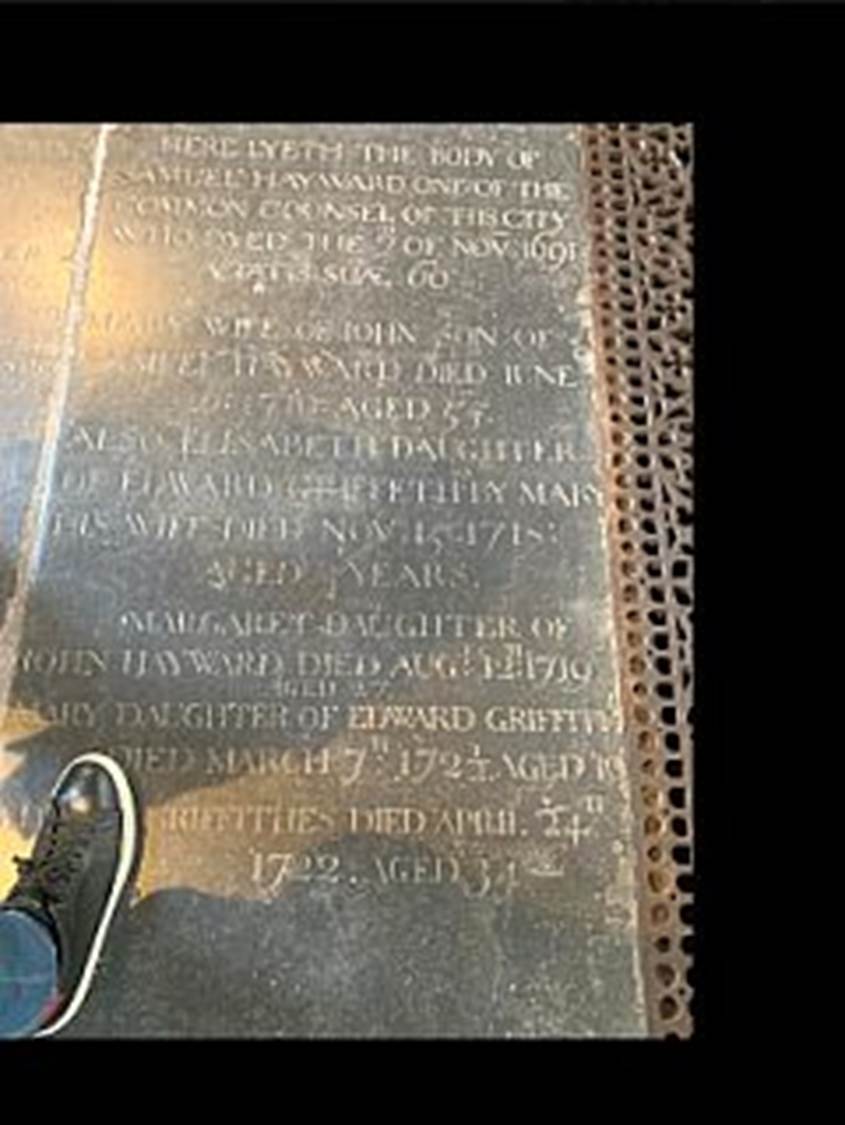
Steve wrote in with a couple of questions about this memorial stone in Bath Cathedral. Close to the mystery foot in this image, the death of Mary Griffith is recorded as March 7th 172 ½ aged 10. Can you now make sense of how Mary’s date of death was recorded? Steve also noticed that there are two spellings of Griffith / Griffeth and wondered why. I offered the thought that the spelling of names was not standardised until much later, and people spelled according to what they heard. Samuel Johnson’s first comprehensive dictionary wasn’t published until 1755 and that didn’t even cover surnames… However, there could be other explanations – Steve would love to hear from anyone whose greater knowledge and experience might shed more light.
This memorial can be examined in more detail here Griffithes Griffith - noting that while the entries for each name can be examined on separate webpages, Mary’s name has been incorrectly transcribed as May. Spoiler Alert: The Cathedral have their own answer to her date of death. So don’t read it until you are ready!
Scribe AI transcription: a full example
Our next article has its origins in the early years of the Industrial Revolution – perhaps at a time when the people living through it were in a similar situation to (or “relationship with”) the current early progression of AI. On reflection, I find it difficult to even imagine living in a world where the standardisation of language, timekeeping, food, transportation of people and goods, healthcare, education, welfare, construction, water and sewage management, and the production of goods and provision services was beyond contemplation in most peoples’ minds. What we have now is still far from perfect, but I’d still prefer all that we have now! That said, the rebuilding of the City of London after the Great Fire in 1666 was mostly achieved within ten years, taking advantage of the disaster to introduce centralised planning and building controls. The urgency to provide new homes for survivors forced to live in the surrounding fields after the fire had to be balanced against the need to avoid further disease and devastation caused by poorly controlled expansion. I once read that the introduction of tea proved vital to the success of the Industrial Revolution because drinking boiled water slashed the risk of cholera in overcrowded and unsanitary cities – perhaps that’s a topic for future examination!
With older documents being so vital to the work of genealogists and many others interested in social, religious and cultural history, getting an accurate understanding from them also means thinking about biases- because these can both influence the answers generated by AI, and our interpretation of what it gives us. This is a human phenomenon that we tend not to be aware of until someone else points it out, and I believe that AI can currently be just as fallible.
Earlier in June, Kevin (UK) emailed me to mention that “MyHeritage has a historical document AI transcription service they introduced recently (Scribe AI) which I've tried on some 18th century indentures and found really good - a pretty accurate transcription, as well good summary of the historical context of the document and the people involved.”
Just a few days Later, Roger (Bristol, UK) wrote in to say that “I have been using the My Heritage Scribe AI to transcribe early Wills, Burials and Christenings. It is the method used in the Daily Mail article mentioned in the May newsletter. The results I've received have been excellent, and they are full of additional information. I've no reason to doubt that all the details are correct. My Heritage does require a subscription, so many Lost Cousins members may not have access to Scribe AI, but I can strongly recommend it.” He added that “MyHeritage allows for a few free uploads to Scribe AI. This might even be enough for some members who are only trialling different sites and/or have very few documents to transcribe.”
Roger enclosed an example of a Will transcription from his own research, so that readers can see what a complete AI transcription service offers. The list of suggestions for further research got me wondering whether Scribe AI had assumed that all of Morris Britton’s offspring were included in the will. There was no suggestion given to systematically check for other children; nor was there any statement that Scribe had already performed that check. Overall I agree that the results look impressive, but I’d still be guided by best (human) research practice.
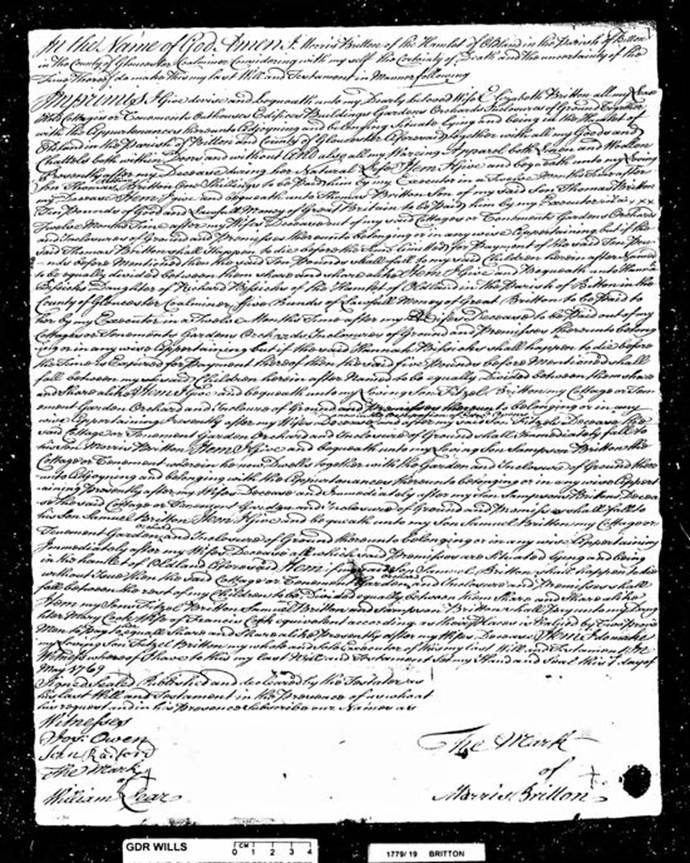
Scribe AI full transcript of 1779 Morris Britton Will
The document you have provided is a Last Will and Testament for Morris Britton, a coalminer from Gloucestershire, England, dated May 7, 1769. It outlines the distribution of his estate, primarily real estate (cottages and land) and monetary bequests, to his wife, children, and grandchildren. This document gives you a fascinating glimpse into the property ownership and wealth distribution of a working-class individual in 18th-century England. The archival tag at the bottom indicates it was likely probated or filed in 1779, which suggests Morris Britton may have died around that year. You will also notice the use of archaic legal phrasing such as 'Imprimis' (in the first place) and 'Two Indifferent Men' (meaning impartial appraisers).
Details mentioned
Principal Individuals:
- Morris Britton: The testator. Occupation: Coalminer. Residence: Hamlet of Oldland, Parish of Bitton, County of Gloucester. Event: Wrote his will on May 7, 1769.
- Elizabeth Britton: Wife of Morris Britton. She is bequeathed all freehold cottages, tenements, goods, and chattels for her natural life.
- Thomas Britton: Son of Morris. Bequeathed one shilling.
- Thomas Britton (Grandson): Son of Thomas Britton. Bequeathed ten pounds.
- Fitzel Britton: Son of Morris. Bequeathed a cottage/tenement after his mother's death and named sole executor.
- Morris Britton (Grandson): Son of Fitzel Britton. Inherits Fitzel's cottage after Fitzel's death.
- Sampson Britton: Son of Morris. Bequeathed the cottage he currently dwells in after his mother's death.
- Samuel Britton (Grandson): Son of Sampson Britton. Inherits Sampson's cottage after Sampson's death.
- Samuel Britton: Son of Morris. Bequeathed a cottage/tenement.
- Mary Cook: Daughter of Morris, wife of Francis Cook. To receive an equivalent share of value from her brothers Fitzel, Samuel, and Sampson.
- Francis Cook: Son-in-law of Morris, husband of Mary Cook.
- Hannah Bissicks: Daughter of Richard Bissicks. Bequeathed five pounds.
- Richard Bissicks: Coalminer of Oldland, father of Hannah Bissicks.
Associated Individuals:
- Jos. Owen: Witness.
- John Radford: Witness.
- William Lear: Witness.
Key findings
- You can see that Morris Britton, a coalminer from Oldland, Gloucestershire, wrote his will on May 7, 1769.
- He left his estate to his wife Elizabeth for her lifetime, after which it was divided among his children and grandchildren.
- His sons Fitzel, Sampson, and Samuel received property, while his son Thomas received a token one shilling (though Thomas's son received ten pounds).
- His daughter Mary Cook (wife of Francis) was to be paid an equivalent share by her brothers.
- Fitzel Britton was named the sole executor.
Suggested next steps
- You should search for the probate record or death index for Morris Britton around 1779 in Gloucestershire to confirm his exact date of death.
- You can look for parish registers (baptisms, marriages, burials) for the Parish of Bitton on MyHeritage to trace the births of Morris's children (Thomas, Fitzel, Sampson, Samuel, Mary) and grandchildren.
- You should investigate the marriage records for Mary Britton and Francis Cook to find their marriage date.
- You might want to explore the connection to the Bissicks family; Hannah Bissicks might be a relative, such as a granddaughter through an unmentioned daughter, or a goddaughter.
Full text transcription
In the Name of God Amen I Morris Britton of the Hamlet of Oldland in the Parish of Bitton in the County of Gloucester Coalminer Considering with my self the Certainty of Death and the uncertainty of the Time thereof do make this my last Will and Testament in Manner following Imprimis I Give devise and bequeath unto my Dearly beloved Wife Elizabeth Britton all my Free Hold Cottages or Tenements Outhouses Edifices Buildings Gardens Orchards Inclosures of Ground together with the Appurtenances thereunto Adjoyning and belonging Situate lying and being in the Hamlet of Oldland in the Parish of Bitton and County of Gloucester Aforesaid together with all my Goods and Chattels both within Doors and without AND also all my Wearing Apparel both Linen and Woollen Presently after my Decease during her Natural Life Item I Give and bequeath unto my loving Son Thomas Britton One Shilling to be Paid him by my Executor in a Twelve Months Time after my Decease Item I give and bequeath unto Thomas Britton Son of my said Son Thomas Britton Ten Pounds of Good and Lawfull Money of Great Britain to be Paid him by my Executor in a Twelve Months Time after my Wifes Decease out of my said Cottages or Tenements Gardens Orchards and Inclosures of Ground and Premisses thereunto belonging or in any wise Appertaining but if the said Thomas Britton shall Happen to die before the Time limitted for Payment of the said Ten Pounds before Mentioned then the said Ten Pounds shall fall to my said Children herein after Named to be equally divided between them share and share alike Item I Give and Bequeath unto Hannah Bissicks Daughter of Richard Bissicks of the Hamlet of Oldland in the Parish of Bitton in the County of Gloucester Coalminer five Pounds of Lawfull Money of Great Britain to be Paid to her by my Executor in a Twelve Months Time after my Wifes Decease to be Paid out of my Cottages or Tenements Gardens Orchards Inclosures of Ground and Premisses thereunto belong =ing or in any wise Appertaining but if the said Hannah Bissicks shall happen to die before the Time be Expired for Payment thereof then the said five Pounds before Mentioned shall fall between my said Children herein after Named to be equally Divided between them share and share alike Item I Give and bequeath unto my loving Son Fitzel Britton my Cottage or Ten= =ement Garden Orchard and Inclosure of Ground and Premisses thereunto belonging or in any wise Appertaining Presently after my Wifes Decease and after my said Son Fitzels Decease the said Cottage or Tenement Garden Orchard and Inclosure of Ground shall immediately fall to his Son Morris Britton Item I Give and bequeath unto my loving Son Sampson Britton the Cottage or Tenement wherein he now Dwells together with the Garden and Inclosure of Ground there =unto Adjoyning and belonging with the Appurtenances thereunto belonging or in any wise Appert =aining Presently after my Wifes Decease and immediately after my Son Sampsons Brittons Decease to his Son Samuel Britton Item I Give and bequeath unto my Son Samuel Britton my Cottage or Tenement Garden and Inclosure of Ground thereunto belonging or in any wise Appertaining Immediately after my Wifes Decease all which said Premisses are Situated lying and being in the hamlet of Oldland Aforesaid Item if my said Son Samuel Britton shall happen to die without Issue then the said Cottage or Tenement Garden and Inclosure and Premisses shall fall between the rest of my Children to be Divided equally between them share and share alike Item my Sons Fitzel Britton Samuel Britton and Sampson Britton shall Pay unto my Daugh =ter Mary Cook Wife of Francis Cook equivalent according as their Places is Valued by Two Indifferent Men to Pay an equall share and share alike Presently after my Wifes Decease Item I do make my loving Son Fitzel Britton my whole and Sole Executor of this my last Will and Testament In Witness whereof I have to this my last Will and Testament Set my Hand and Seal this 7th day of May 1769 Signed Sealed Published and declared by the Testator as his last Will and Testament in the Presence of us who at his request and in his Presence subscribe our Names as Witnesses Jos. Owen John Radford The Mark of William Lear The Mark of Morris Britton
Morris clearly had a lot more wealth to dispose of than a typical coalminer in later times, so I did wonder whether “coalminer” really meant “mine owner”. I’m not sure what conclusion to draw from this Google AI explanation:
The "Collier" Distinctions: In 18th-century parish registers and wills (such as his will witnessed in 1779 following his 1777 death), family members are consistently identified with the abbreviation "cm" (coal miner/collier) rather than "coal merchant," "gentleman," or "pit owner".
More on AI Transcriptions
While AI might not seem relevant to everyone, it will be ubiquitous before too long - and the younger generations of genealogists will ultimately be reliant on the vigilance and healthy scepticism of their older cousins in helping to shape its development through how we choose to use it now. I recently read that the UK veterinary industry is very concerned that many pet owners are trusting AI in favour of seeking expert medical treatment; is this about impatience, convenience, saving money- or something else?
Similarly, an article in the Daily Mail UK (don’t worry, I browse several newspapers) invites readers to identify human faces vs those that are AI generated. The point of the article is to show how the differences are becoming harder to spot. While I consistently score well on the “super recogniser” tests that pop up from time to time, I only scored 9/10 and feel weirdly disturbed about the one I missed: https://www.dailymail.com/sciencetech/article-15937659/distinguish-AI-generated-faces-test.html
For a wider discussion about AI, this provocative article on AI in the Guardian UK newspaper offers the suggestion that completely avoiding AI is likely to be just as bad as mindlessly embracing it. Although there is “No Control Group” because the AI experiment was not constructed as a closed scientific experiment, this doesn’t mean that societies should roll over and accept it without critical analysis. But to analyse, we must first be willing to engage with it.
Many readers might discover that a single AI source does a good enough job for their needs. Larry (USA) mentioned that “reading the article on AI, I wanted to share that I have found the best transcriptions come from using Gemini. I tried them all and it was by far the best.”
Andrew (Bristol, UK) commented that “I have also had mixed experiences with both ChatGPT and Grok. AI platforms tend to produce something which looks credible, but as David Snow said, they can miss huge chunks of source text and "helpfully" make things up. The only way I made headway with ChatGPT was to tell it that I wanted each line transcribed and to number the lines in the output. At least it then became obvious where it was inaccurate.”
[Thanks Andrew, this seems a good way to overcome the tendency of AI to “fill in the blanks” even without sound evidence. Which, as a social historian university tutor once pointed out, is something else that humans are very good at doing!]
Andrew went on to say that “I asked a couple of AI engines "what is the best site for transcribing old documents?" The site which came at or near the top was https://www.transkribus.org/
My experience is that Transkribus does a faithful transcription of all sorts of handwriting styles and lets you download or just copy/paste the transcribed text. It's free, but often says its servers are busy, and to try later (i.e. another day!). I copy the transcriptions into Word and then tidy up anything it could not handle.”
And now here’s an interesting coincidence… I recently discovered that Peter had been subscribing to Claude AI, although I believe that he was more interested in using this service for drafting, interpreting and summarising documents “in the now”. But even more interesting was his charitable support of Transkribus, which I only found out about a day or so before reading Andrew’s email. Peter didn’t part easily with his pennies but could be very generous towards causes that genuinely impressed him. If you’d like to understand more about Transkribus, this link explains the project in more detail: https://dukespace.lib.duke.edu/server/api/core/bitstreams/9a6e6ee0-b190-4570-a13d-3164825adc85/content
Finally, Val (UK) suggested a more familiar resource: “I use Rootschat online forum - handwriting section - for mystery words. The people on there are fantastic!” So perhaps a combination of AI and careful “human” checking is the way to go for the time being.
Events in July (this only includes those that are brought to my attention!)
TNA Archives Fest 2026- a day out at The National Archives in London on 12th July.
https://www.nationalarchives.gov.uk/whats-on/events/archives-fest-2026/
Unless the heat stops the trains from running, this will be the first mainstream genealogy event this year that I will be attending. Looking forward to the day’s experience.
The Society of Genealogists (SoG)- online programme
Always worth an occasional browse, the SoG’s list of events list has something for everyone. Most are online and all are excellent value, especially with Gold membership. Else Churchill’s Summer School this year on “Wills and Probate Records” starts on 13th July. Janet Foster’s “Deciphering Victorian Handwriting in 5 days” starts a week later and examines how to tackle the highly individualised styles of handwriting which emerged during the 1800s. In celebration of 250 years of American Independence, there is a special collection of online presentations throughout July that explore researching ancestors who settled in the USA, which might interest readers on both sides of the pond. And for SoG members, the AGM will be on 28th July.
https://portal.sog.org.uk/event/list
Last Word
While pulling this newsletter together I noticed that several of this month’s contributors are based in Bristol - is there a special reason for this? A very big thank you to all this month’s contributors for your fascinating articles and observations. Next time I’m hoping to publish an article about a bigamist in the family tree, from one of our members in New Zealand. Do keep your contributions coming as the feedback has been very encouraging. I am planning to introduce one or two of my own ancestors later this year – starting with my very first irresistible challenge. Stay safe and well, wherever in the world you are!
Sian Lloyd,
Lost Cousins
The LostCousins newsletter is usually published 2 or 3 times a month. To access the previous issue (dated 1st May) click here; to find earlier articles use the customised Google search between this paragraph and the next (it searches ALL of the newsletters since February 2009, so you don't need to keep copies):
To go to the main LostCousins website click the logo at the top of this newsletter. If you're not already a member, do join - it's FREE, and you'll get an email to alert you whenever there's a new edition of this newsletter available!
© Copyright 2026 Sian Lloyd and Lost Cousins Limited
Please do NOT copy or republish any part of this newsletter without permission - which is only granted in the most exceptional circumstances. However, you MAY link to this newsletter or any article in it without asking for permission - though why not invite other family historians to join LostCousins instead, since standard membership (which includes the newsletter), is FREE?
Many of the links in this newsletter and elsewhere on the website are affiliate links – if you make a purchase after clicking a link you may be supporting LostCousins (though this depends on your choice of browser, the settings in your browser, and any browser extensions that are installed). Proud to be an Amazon Associate and an eBay Ambassador.